Love, Qi & Cellular Regeneration
How Emotional Safety Restores the Emperor Within
February with Valentine’s Day and the Lunar New Year invites us to think about love. But in Traditional Chinese Medicine, love is not just romantic. It is regulatory.
It is biological.
It is cellular.
In TCM, the Heart is called the Emperor. The Emperor governs clarity, consciousness, and the stability of the entire kingdom. When the Emperor is calm, the ministers (the other organs in the system) function well. When the Emperor is agitated, the kingdom destabilizes.
Modern physiology describes the same truth differently.
When the nervous system feels safe:
- Immune signaling improves
- Inflammation decreases
- Hormones regulate
- Cells repair
When the nervous system remains in threat activation:
- Cortisol rises
- Inflammatory pathways increase
- Digestion falters
- Repair slows
Ancient language described this as Fire rising without Water to anchor it. Modern science calls it chronic sympathetic dominance without parasympathetic recovery.
Both point to the same conclusion:
Healing requires emotional safety.
The Heart–Kidney Axis: Love Meets Longevity
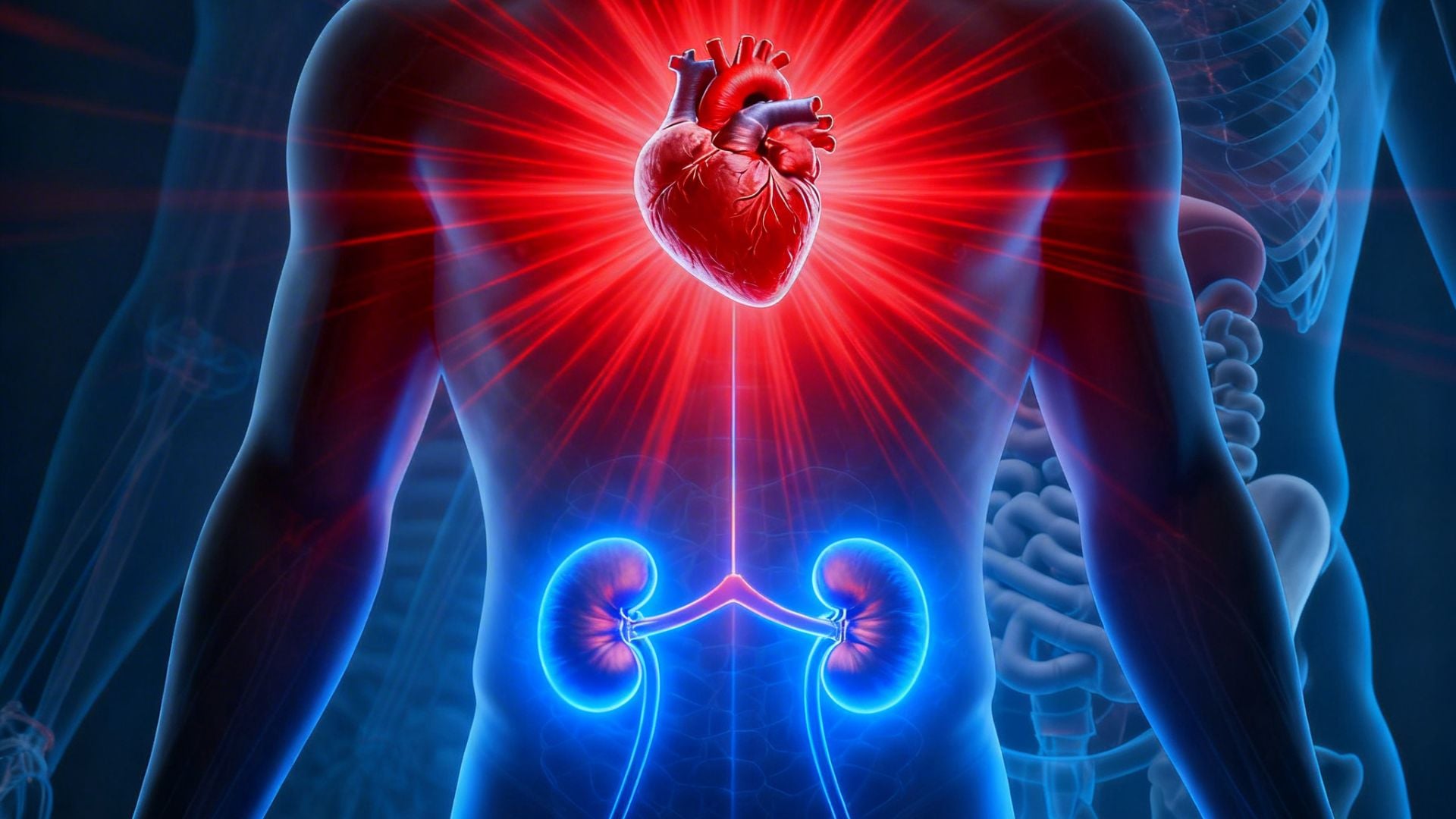
In TCM, the Heart (Fire with related emotion, over-excitedness) and Kidneys (Water with related emotion fear) must communicate.
The Heart governs awareness, joy, and spirit (Shen).
The Kidneys store Jing—our deep reserves of vitality, resilience, self-confidence and reproductive and regenerative potential.
When Fire is excessive and Water is weak:
• Anxiety rises
• Sleep becomes disrupted
• Hormones destabilize
• Immune function weakens
When Fire and Water are in harmony:
• The mind is clear
• The emotions regulate
• The body repairs
• The immune system strengthens
This is what we call Heart–Kidney coherence.
And coherence is not a metaphor.
It is measurable
Heart rate variability research shows that emotional regulation improves immune response and reduces inflammatory load. Oxytocin—often called the “bonding hormone”—plays a role in reducing stress signaling and promoting tissue repair.
In TCM terms, when the Emperor feels safe, the kingdom repairs itself.

Love as a Biological Signal
We often think of love as an emotion.But biologically, love is a signal.
Safe connection—whether through relationship, breathwork, or embodied practice—tells the nervous system:
“You are not under threat.”
When that signal is received:
• Cortisol lowers
• The vagus nerve activates
• Digestion improves
• Immune cells function more efficiently
• Cellular repair accelerates
From a Qigong perspective, this is when Qi flows smoothly.
From a biomedical perspective, this is when inflammation resolves and regeneration begins.
The body does not regenerate in a state of chronic alarm.
It regenerates in safety.
The Rhythm of Harmony → Disharmony → Repair
In my upcoming ebook, The Emperor Within Restoring Heart–Kidney Coherence, A Qigong and Chinese Medicine Perspective, I describe a simple but powerful rhythm:
Harmony → Disharmony → Repair
Every nervous system cycles through this rhythm.
Every relationship cycles through this rhythm.
Every cell cycles through this rhythm.
The goal is not to eliminate stress.
The goal is to strengthen repair.
When repair is missing, disharmony becomes chronic.
When repair is restored, resilience returns.
Qigong trains this rhythm deliberately.

Qigong as a Regenerative Practice
When we practice Qigong slowly and with awareness:
• We regulate breath
• We calm the sympathetic stress response
• We stimulate parasympathetic tone
• We improve circulation to fascia and organs
• We signal safety
Self-patting, gentle spirals, vertical alignment between Heaven and Earth—all of these are not just movements. They are regulatory signals.
They tell the Emperor:
“You are safe enough to soften.”
And when the Emperor softens, the kingdom repairs.
This is why practices like Bone Marrow Washing Qigong are foundational. They nourish the Kidney system—the root of regeneration—and anchor excessive Heart Fire.
This is also why February, the season of the Heart, is not just about romance.
It is about restoring internal coherence.
Emotional Safety Is Not Weakness
Many of us were taught that strength means endurance.
But true resilience is not the absence of stress.
It is the capacity to return to regulation.
The Heart does not demand stillness.
The Heart demands balance.
When we conserve Jing, regulate Fire, and cultivate steady Qi flow, cellular repair becomes more efficient. Immune resilience improves. Hormones stabilize. Sleep deepens.
Love, in this sense, becomes medicine.
Not sentimental.
Physiological.
Continuing the Work
This blog is a small window into a much deeper exploration.
In my upcoming ebook: The Emperor Within: Restoring Heart–Kidney Coherence, A Qigong and Chinese Medicine Perspective, I expand on:
• The biology of cortisol and chronic activation
• Oxytocin and cellular repair
• Fascia and the body’s memory
• Practical Qigong sequences for Heart–Kidney integration
• A 7-day plan to restore coherence
If this reflection resonates with you—if you sense that your healing requires not more force, but more regulation—then this work is for you.
The Emperor does not demand perfection.
The Emperor demands harmony.
And harmony is cultivated.
Research Perspective
Emerging research supports the regulatory role of oxytocin in stress resilience. Oxytocin has been shown to inhibit stress-induced activation of the HPA axis and reduce cortisol production under certain conditions (PMC, 2019).
Oxytocin & Cortisol Modulation (PMC Article)
APA Citation:
Neumann, I. D., & Slattery, D. A. (2016). Oxytocin in general anxiety and social fear: A translational approach. Biological Psychiatry, 79(3), 213–221. https://doi.org/10.1016/j.biopsych.2015.06.004
More recent work highlights the dynamic, context-dependent “Yin and Yang” nature of oxytocin in modulating stress responses (Frontiers in Endocrinology, 2024).
Yin & Yang of Oxytocin (Frontiers in Endocrinology, 2024)
APA Citation:
Frontiers in Endocrinology Editorial Team. (2024). The Yin and Yang of oxytocin: Context-dependent effects in stress regulation. Frontiers in Endocrinology, 15, Article 1272270. https://doi.org/10.3389/fendo.2024.1272270
While Qigong itself is not a pharmaceutical intervention, practices that cultivate emotional safety, breath regulation, and parasympathetic tone may support the physiological conditions associated with improved stress regulation and recovery.
Enter your name and email to download the PDF version of this blog.
Thank you! The blog should be delivered shortly.
Otherwise contact us at: support@qi-mastery.com
Ready to Restore Your Heart–Kidney Coherence?
If you are navigating stress, hormonal changes, immune imbalance, or simply feel disconnected from your own vitality, you do not have to do this alone.
You can work with me through:
• Private acupuncture sessions in Cupertino
• Small group Qigong workshops
• The QiMastery App for guided home practice
• Upcoming retreats focused on Heart–Kidney integration
Healing is not forced. It is cultivated — with guidance and consistency.